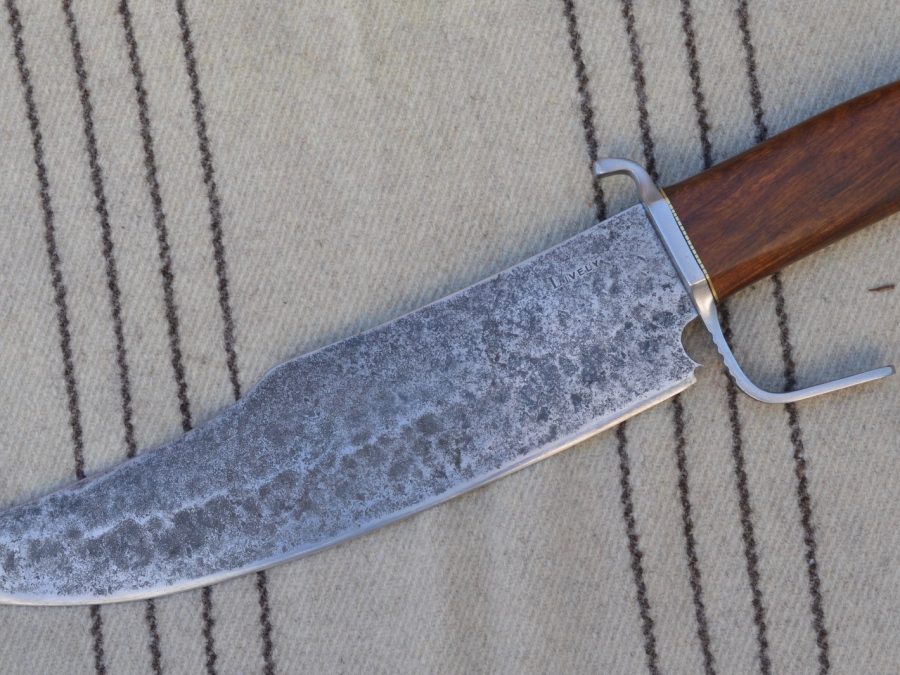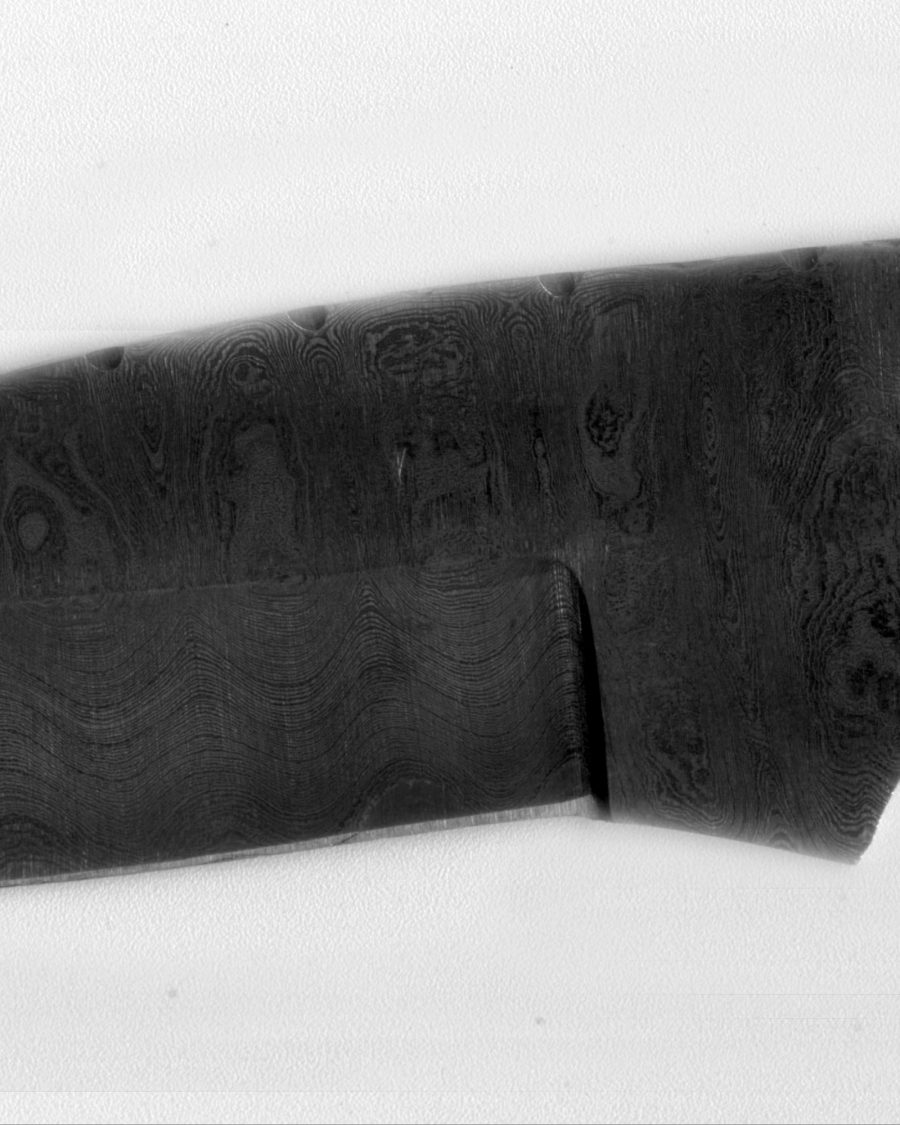
This one starts as a square-cross-section billet of alternating 1080 and 15N20, drawn out long and thin, then twisted under the power hammer while still hot enough to move — around a full rotation every inch and a half of bar length is our working target, tight enough to read clearly but not so tight the layers tear apart at the surface. Two twisted bars, usually turned in opposite directions, are then forge-welded together side by side.
The opposing twist directions are what make the pattern read as a continuous spiral band across the blade rather than a repeating chevron — weld two bars twisted the same direction together and the pattern tends to look flatter and more static by comparison. It’s a more failure-prone process than straight folding; a twist that’s uneven along its length shows up immediately as an irregular spiral once etched.