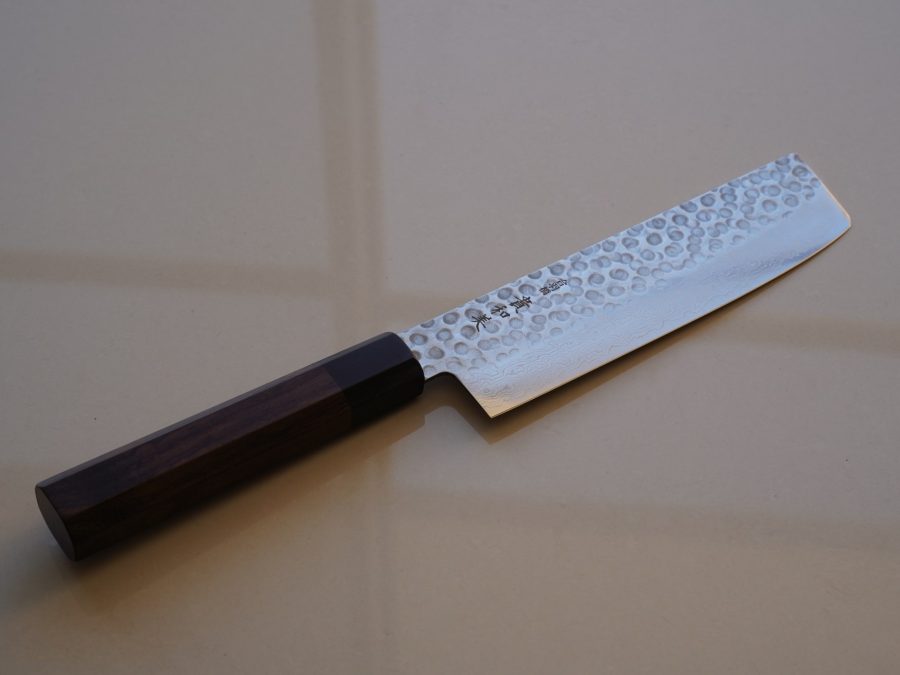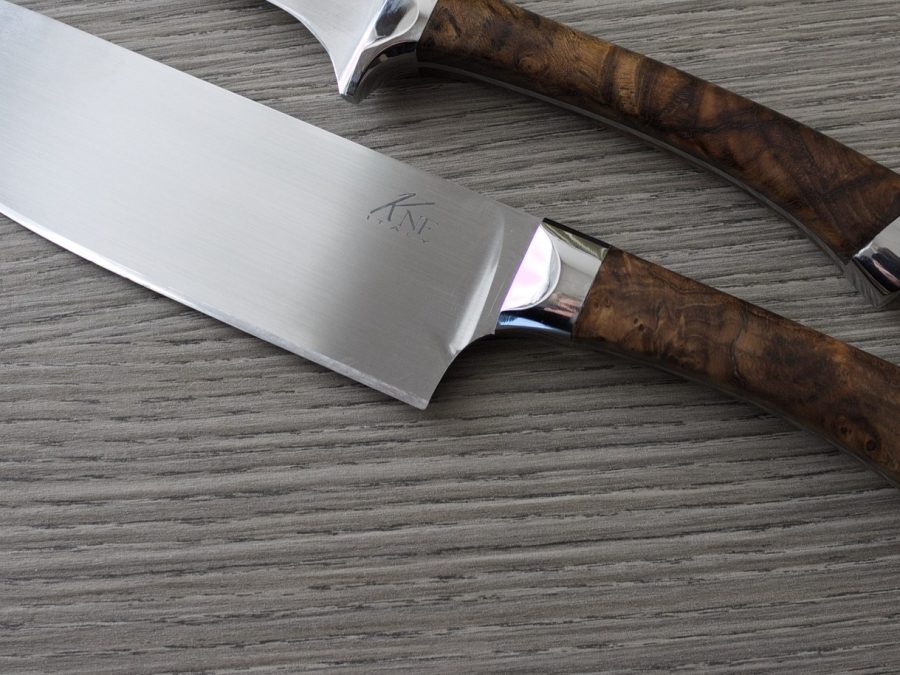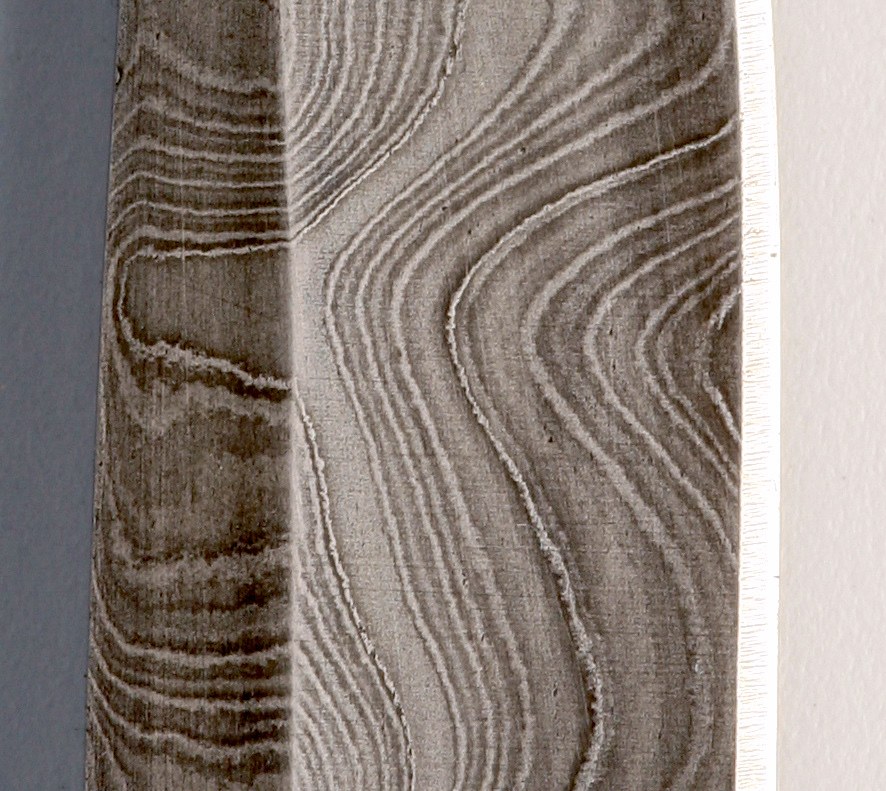
This is our default pattern-welded steel and the one most of our chef’s knives ship in. We start with alternating 0.08″ bars of 1084 (plain high-carbon, no alloying elements to slow the etch) and 15N20 (nickel-bearing, which stays bright where the 1084 goes dark in ferric chloride), forge-weld the stack, and draw it out and fold it roughly four to five times — each fold doubles the layer count, so five folds from an eight-layer starting stack lands us around 256 layers, and we round that up in practice to 300 accounting for uneven draw.
The ladder motif itself isn’t a folding pattern — it’s produced afterward by filing a series of transverse grooves into the flat of the drawn-out billet before final forging, which locally disrupts the layers and pulls them into the rung shapes you see after etching. Get the groove spacing uneven and the ladder reads as sloppy rather than deliberate, so we jig the spacing rather than eyeball it.