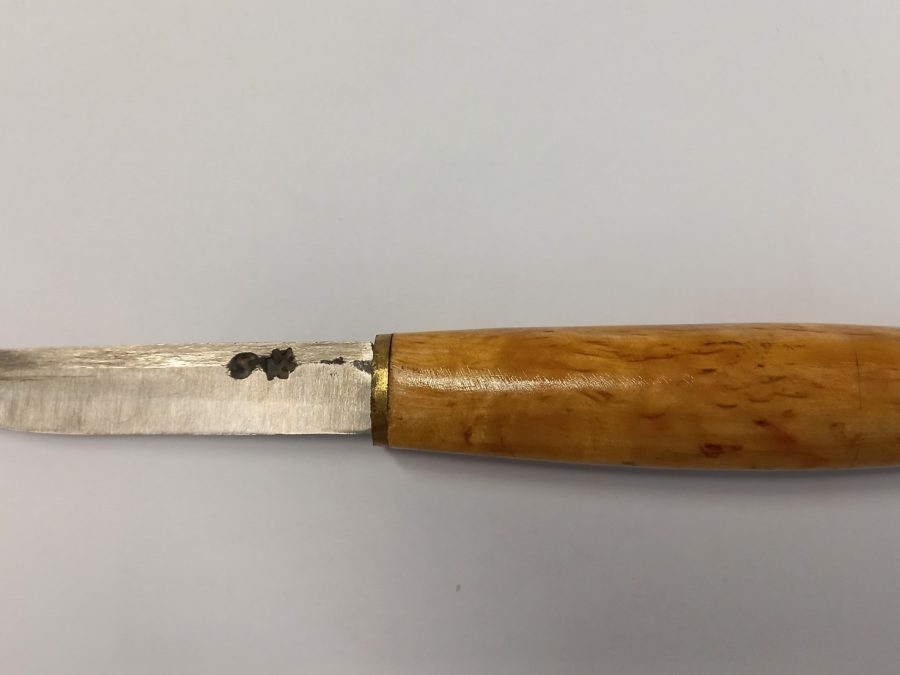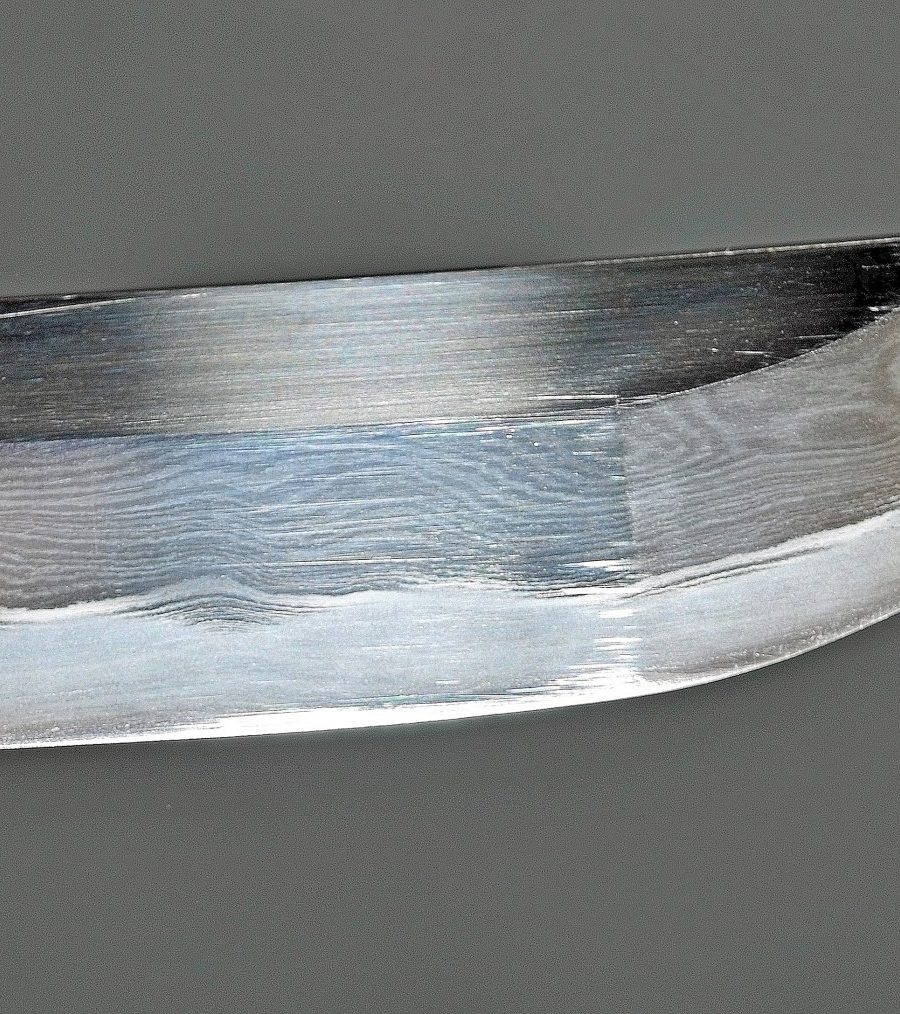
W2 is a plain carbon steel with a small vanadium addition that keeps the grain fine even at the higher austenitizing temperatures a hamon needs. There’s no folding or layering here — the visual interest comes entirely from how the steel is heat treated, not how it’s built up. We coat the spine in a thick refractory clay and leave the edge bare, then quench in fast oil; the exposed edge cools quickly enough to form hard martensite while the clay-insulated spine cools slower into softer pearlite, and the boundary between the two structures is what becomes visible as the hamon line after a careful etch and hand-polish.
Because the transformation is genuinely differential, the hamon line’s shape is never identical twice — clay thickness, quench angle, and oil temperature all shift it slightly, which is the honest reason no two of our W2 blades show quite the same cloud pattern along the edge.